Mumbai | Undercover Editor News Channel, January 29, 2026
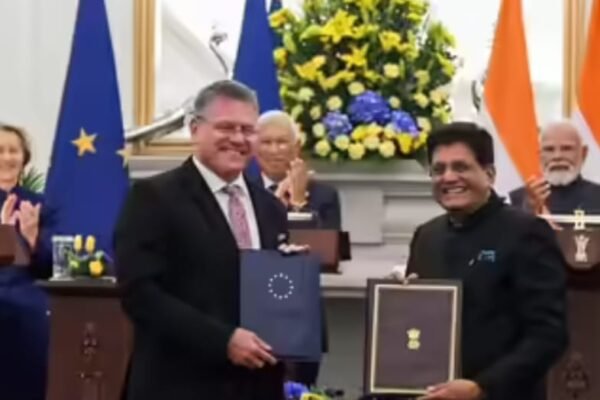
New Delhi: Union Commerce and Industry Minister Piyush Goyal on Wednesday launched a sharp counterattack against the Congress after senior leader Jairam Ramesh described the India–European Union Free Trade Agreement (FTA) as “hugely hyped.” Defending the pact, Goyal said the criticism reflected political frustration rather than economic reasoning, calling the agreement a “landmark, win-win deal” for India.
Reacting to Ramesh’s social media post raising concerns over trade deficits, automobiles, intellectual property rights, refined fuel exports, and the European Union’s Carbon Border Adjustment Mechanism (CBAM), Goyal questioned the Congress party’s credibility on trade negotiations.
“Is this a case of sour grapes?” the minister asked, remarking that those who failed to act while in power were now attempting to undermine a deal of historic scale. He said India paid a “heavy economic price” when FTA talks were stalled between 2013 and 2022, costing the country jobs, exports, and growth opportunities.
Rejecting the charge that the agreement was over-sold, Goyal highlighted the size and significance of the pact, describing it as one of the world’s largest trade agreements. He pointed to the combined GDP of nearly USD 25 trillion, annual trade of USD 11 trillion, and access to a common market of almost two billion people.
The minister emphasised that tariff elimination on USD 33 billion worth of India’s labour-intensive exports from the very first day would deliver immediate benefits to Indian workers, exporters, and small businesses.
Responding to Congress’s warning that the FTA could widen India’s trade deficit due to tariff reductions on over 96 per cent of EU exports, Goyal said the agreement was carefully negotiated to protect domestic interests while expanding India’s global footprint.
On CBAM, which the Congress said could hurt India’s aluminium and steel exports, Goyal said the government had proactively engaged with the EU to identify solutions through dialogue and cooperation. He stressed that India had not adopted a rigid stance and remained confident of safeguarding national interests.
Addressing concerns over regulatory standards, Goyal clarified that health and safety norms remained intact under the agreement and were structured to prevent unjustified trade barriers. On intellectual property rights, he said provisions were aligned with the WTO’s TRIPS framework, preserving public health safeguards, technology transfer rights, and recognition of India’s traditional knowledge systems.
The minister also dismissed fears regarding services and automobile imports. He said services commitments stayed within India’s existing domestic framework, while automobile liberalisation was quota-based, limited to premium segments, and phased. Electric vehicle imports, he added, would see a five-year lag, giving Indian manufacturers time to strengthen their capabilities.
Goyal said the policy would encourage European manufacturers to shift from imports to local production, boosting the Make in India initiative and creating jobs.
On refined fuel exports — India’s largest export category to the EU — the minister said trade flows were influenced by global factors and that the FTA represented a long-term strategic partnership built on trust and mutual respect.
“I hope the opposition sheds this pessimistic outlook,” Goyal said, adding that the government’s priority was to expand opportunities for Indian youth, businesses, and workers, not to act as a roadblock to economic growth.
India and the European Union began negotiations for the FTA in 2007. After 16 rounds, talks were suspended in 2013 due to unresolved issues and resumed in June 2022. The agreement was finalised and announced this week, nearly 18 years after negotiations first began.